History of Field View Cameras
Early history1800s
Field Cameras Origins
American Cameras
Modern History
Early history
When you think of photography, you may think of it as a fairly modern invention. On the contrary, photography began with the camera obscura as early as the 10th century AD, and some evidence seems to indicate that Aristotle was familiar with this technique as early as the 4th century BC. The camera obscura was a darkened room with a tiny hole in one wall with a white screen on the opposite wall. In the middle of the 16th century, lenses were added to the hole of the camera obscura to produce a brighter, sharper image. Over time, the camera obscura became more compact, and the image was projected onto thin paper on glass so it could be traced. This was used as a sketching aid by artists.Sketching the images on the camera obscura took extra time, but in 1725 Johann Heinrich Schultz learned that exposing certain silver salts to light could capture the image without tracing. Over the next 75 years, scientists investigated these properties of the silver salts, but none could practically use the discovery to produce permanent images.
1800s
In the early 1800s, the camera obscura had become a portable, light-tight box that contained materials and chemicals that would momentarily record the image through the lens. Cameras created in the 1800s were often crafted for looks as well as functionality. For instance, fine woods were used with brass fixtures to showcase the equipment. Wood had the advantage over metal as it was lighter and the camera could be made larger, which would give the photographer more movement and extension. The wood was also exceptional for dampening vibration, which could affect a metal camera and blur the picture. On the other hand, the metal cameras had the advantage of less flexibility for long extensions. The metal cameras could be knocked over with little damage, while the wooden cameras could be shattered if they hit the floor.In 1816, Joseph Niépce and his Brother Clyde successfully produced a paper negative from the image. When they sandwiched this negative with another piece of sensitized paper, a positive image would appear. Unfortunately, there still was no way of making these images permanent.
Niépce decided to use pewter plates coated with bitumen of Judea, which was an asphaltic varnish that hardened when exposed to light. He originally exposed these plates to some light through an oiled etching on a piece of paper, and washed the plates with a solvent after exposure to remove the hardened parts of the image. This created a positive representation of the etching on a metal plate, which was called a heliograph. The plate was then etched with acid, inked, and printed.
Niépce decided to place the light-sensitive plates within a camera and expose them, which produced the first permanent photographs around 1826. The camera needed about eight hours for proper exposure. These positive images were too faint for repeated printing, so the photographs were one-of-a-kind. This process did not use the light sensitive silver salt and could reproduce the image in light and dark tones with no color. He continued to attempt to improve his process.
Another Frenchman, Louis Jacques Mandé Daguerre used the camera for his sketches and experimenting with the light-sensitive silver salts at around the same time as Niépce's experiments. Eventually, Niépce and Daguerre worked together to further their research. Daguerre finally used a copper sheet plated with silver that had been polished and fumed with a vapor of iodine to produce the light sensitive silver iodide on the plate's surface. This plate was then placed into the camera and exposed to the image. The plate was treated after exposure with the fumes from heated mercury to produce a stronger, more visible image, which was then fixed with salt water. This produced a silvery, delicate, monochromatic image that was unique. Daguerre called his invention the daguerreotype.
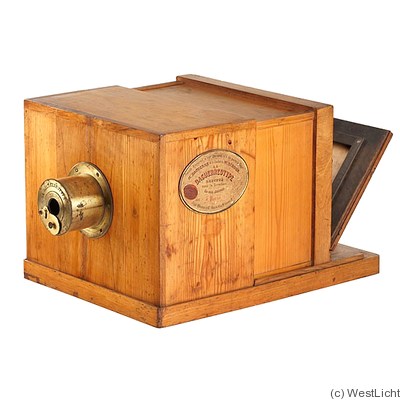
Giroux Alphonse Daguerreotype Camera
In 1839, William Henry Fox Talbot of England learned of the new photographic technology. He had begun to experiment with these processes in 1834, and learning about Niépce and Daguerre's invention, brought his own to the Royal Institution and the World Society by the end of that January. He used paper that had been sensitized with silver chloride, upon which he placed objects. These were exposed to light in what are now called photograms. Later, he exposed the paper to an image in the camera to produce a negative image that he fixed by bathing the paper in salt water. He would then create a positive image by placing it against a second sheet of sensitized paper and exposing both to light using the contact printing method. Talbot continued to work with his camera to invent the calotype, and during this time he sensitized paper with silver iodide. Exposure to light would produce a latent image; however, he learned this negative image could become visible with a chemical development in a second wash of gallo-nitrate of silver. The print was then fixed with a solution of potassium bromide. The development of this latent image resulted in less exposure time. The negative image was then contact printed to another sensitized paper sheet to produce a positive image.
Over the next several years, other inventors attempted to improve the photographic process. One English man, Sir John Herschel, discovered sodium thiosulfate provided a true fixative for the images. He originally misidentified the substance as sodium hyposulfite, and nicknamed the substance hypo. This term is still used today for photography fixative.
Field Cameras Origins
Two Americans, W.H.E. and H.J. Lewis patented a new daguerreotype camera in 1841. The Lewis model was the first to use internal bellows from its lens to the glass plate. This allowed the cameras to collapse for easier transport, as many photographers were travelling with their rigs. The new design also allowed them to focus and change the perspective of their pictures.The swing lens and balance system is still used in modern view cameras, and allow the photographer to control the convergence of parallel lines and focus. By moving the rear or front standards, the perspective and focus can be altered. The front and rear standards may not always have movement, but some have mechanisms that allow the photographer to make intricate movement combinations. The rising and falling movements of the front or rear standard were along the vertical plane of the film. The rise is used for architectural photography and tall shots to alter the proportions of the object on the film. For instance, a photographer would use rise to shoot a building and ensure the top would remain in perspective to the bottom, rather than growing thinner as the eye travels to the top of the building. When the photographer shifted the front or back standard to the right or left, the shift moved the image horizontally. This was used, for instance, to remove the camera's image from the shot if the photographer was shooting reflective surfaces. Tilting the lens backwards or forwards was called lens tilt and was used for landscape photography, as well. This allowed the shooter to move the plane of focus to select the area in front of the lens that would be clear. Again, these methods are still used by photographers with modern view cameras.
Most of the earliest cameras were made of wood, leather, and brass (some metal cameras were introduced as well) with no mechanical parts, and were sized according to the sheet film they utilized. They were available in 5x12, 7x 17, and 8x20 inches. The material of the camera's body depended on the price and quality of the camera. The more expensive cameras used leather or cloth for the bellows, while later, less expensive models used treated paper. The continuous movements of the bellows wore out the paper faster, and leather was seen as the superior material. As the cameras were often used outside, the photographers needed to take extra care of the leather to keep it from drying, crumbling, or rotting. The cloth bellows were superior, as they did not rip like the paper or dry out like the leather. Today, many current collectors of these view cameras still face the problem of dulling and deterioration to the leather in antique cameras.
In order to use the view camera, the photographer was required to set the camera up in the most suitable position to photograph the subject. When ready to take the picture, the photographer would open the shutter of the lens to project the image on a ground glass placed on the rear standard plate in order to focus. The ground glass was fixed in the same vertical plane to frame and focus as the film would be, before the film was added. As this image was dim and difficult to view in daylight, the photographer used a dark cloth over his or her head to keep the light out of the viewing area to see the picture more clearly. Some photographers used magnifying lenses to perfect their focusing process. Although the taking lens was dropped down to gauge depth of field, the image on the ground glass was opened wide to allow proper focusing. The ground glass was pulled back, and the glass sheet slid into place. The shutter was then closed, the dark paper was removed from the glass to reveal the chemicals, the shutter was triggered to make the exposure, and the dark slide was replaced in the film holder to protect the latent image until it could be developed.
In 1843, an Austrian chemist named Joseph Puchberger patented his swing lens panoramic camera that featured a bellows and hand crank. This camera produced a view image that showed 150 degrees of landscape with an 8 inch focal lens. Others invented further specialized cameras, including more panoramic models.
The negative-positive system discovered by the earlier researchers encouraged photographers and scientists to search for a process that would provide the detail and sharpness of a daguerreotype with the reproducibility of the negative-positive system. Several inventors decided to use glass plates coated with silver halide rather than paper. Edward Anthony created an improved box camera in 1847 called Edward Anthony's Improved, Rosewood and Champered daguerreotype camera. This half plate model used ground glass and a holder with a double trap door, top loaded for field use, and featured expandable rear focusing.
In 1847, Niépce de Saint Victor, a cousin of Joseph Niépce, invented one of the first successful glass plate techniques. He used albumen, or egg whites, as a clear substance to carry the silver salts and stick to the glass. However, albumen plates were not as sensitive as the calotype or daguerreotype, and required extremely long exposure time. This caused photographers to look elsewhere, although the albumen and silver salt mixture was found to provide a smoother finish with better detail when applied to paper than a silver salt mixture that had been used previously. Albumen papers became very popular.
Later, in 1851, an English sculptor named Frederick Scott Archer discovered collodion in 1851. This was a carrier for silver salts made by dissolving gun cotton, or nitrocellulose, in alcohol or ether to create a clear liquid that would stick to glass and dry to a transparent finish. The collodion was mixed with potassium iodide and then applied to the glass plate, which was sensitized by dipping it in potassium iodide solution to form silver iodide. The plate needed to be exposed and developed before the collodion dried, or the developing chemicals would be unable to penetrate. This became known as a wet plate process. The results were superior, and the glass negative could be printed over and over, while providing the sharpness and detail similar to the daguerreotype. The majority of studios were using the wet plate process by the end of the 1850 rather than the daguerreotype process.
There were some major disadvantages to the wet plate process. The coating, exposure, and development had to be done while the chemicals were wet on the plate, so the photographers needed to carry complete darkroom setups with them whenever they wished to take a picture. The glass plates were also fragile and very heavy. Because the photographic papers had a slow development time, printing and enlargement were impractical so the photographers relied on contact printing. The plates needed to be the same size as the photographic prints, and the cameras that would fit these plates were very large as well. Since many photographers were shooting the American west and war scenes, all the equipment needed called for a mule or wagon for transport.
Thomas Ottewill approached the issue of the large cameras by creating a compact folding model intended for use by the military during the Civil War. Other companies began producing cameras with the new leather bellows that could be folded for travel. In 1856, C.G.H. Kinnar designed a camera that featured a tapered bellows in which the parallel-sided bellows could be folded into itself. These inventions were the actual beginning of photojournalism, as photographers traveled across the country between battlegrounds to take pictures of the Civil War encampments and battles. During the first years of the war, the wet plate photographic process was still used, which made the photographers camera and equipment bulky and hard to maneuver. They also needed to move quickly, as the collodion had to be mixed from dangerous chemicals that included sulfuric or acetic acid and ethel ether. This mixture had to be added to the plate, inserted into the camera in total darkness, and the shot taken before the chemicals dried. The images they captured allowed them to accurately communicate the state of the soldiers and wars to civilians who did not experience the fighting firsthand. They were shocked by the actual carnage of warfare, and the pictures stripped the Victorian-era romance many had concerning battle.
Although this technology may seem primitive, many wartime photographers were producing three dimensional images which were called stereoviews. Two pictures from slightly difference angles were shot, then placed side by side onto the stereoview card, which would be placed into a stereo viewer to create a 3-D image.
The view cameras' used relatively simple designs. The wooden boxes contained the bellows, which could be retracted and folded up to make the camera smaller and more portable. Some cameras used a monorail system, while others had two sliding rails. The double rails kept the camera from folding as small as the monorail design, and the rear standard may have been fixed and so it could not move.
The shot was composed and focused on the rear ground glass plate. The frame assembly and ground glass were held in place to hold the glass firmly for the plane of focus during composition and focusing. When the picture was focused, a flexible mechanism clamped the film holder to the same focus plane of the ground glass. The shutter was then closed, and the photographer placed the chemical-coated plate inside the camera in total darkness. The shutter was triggered to make the exposure, and the camera was taken into a dark room to remove the exposed plate for development.

Adolph Bertsch, Chambre Automatique Camera
Researchers continued to look for new processes to eliminate the wet plate process, which required large cameras, plates, and dark room setups. They began to research dry plate methods that had the sensitivity of the wet plate. This was finally created by Richard L. Maddox in 1871, when he discovered that gelatin worked as an excellent carrier for the silver salts. These dry plates allowed the manufacturer to carry the glass to the site, expose it, and then put the plate away to be developed at the photographer's leisure. The gelatin plates were made in a factory, which standardized the materials in the photography world.
Next, photographers and inventors worked to replace the fragile, heavy glass plates with a lightweight, more flexible material. Although this idea was conceived earlier, George Eastman invented the first practical way of manufacturing this flexible rolled film on a cellulose base in 1884.
American Cameras
American Optical, a company that specialized in treating spectacles and lenses, decided to enter the camera manufacturing business and acquired the Scovill Company in 1867. Scovill functioned as the company's primary camera maker. The pieces offered by the two companies were very similar, although the Scovill cameras were less expensive and geared towards the amateur market. American Optical's cameras were more expensive and were constructed of finer woods and high quality finishes. Both companies offered cameras with front focusing, cone bellows design, hinges, and swing backs.E. & H.T. Anthony & Company was known as an American manufacturer of large, professional cameras in the mid-1880s. However, they offered a smaller apparatus called the patent Bijou that featured 3 ¼ by 4 inch lantern slides, which were quickly becoming the preferred format. These plates were the same size as plates used for magic lanterns, and slides were made from the plates by contact printing using ordinary frames. Magic lanterns were early image projectors from the 17th century that used a concave mirror and light source to project an image through the lens on to the screen or wall opposite the mechanism.
Bausch and Lomb began to manufacture photographic lenses in 1883. This company had created eyeglasses and frames for several decades, but Edward Bausch, the son of the founder John Jacob, used knowledge of the human eyes workings to invent the diaphragm shutter. In 1888, the company began to produce diaphragm shutters and dominated the photography market by signing an exclusive agreement with Zeiss Company for their lenses. They were the only company allowed to use Zeiss lenses in the United States. During the same year, the first dry plate detective camera was patented by William Schmid.
.jpg)
The Kodak (original)
A transparent film base made from nature cellulose was invented by Hannibal Goodwin, but he was not able to patent it before Eastman began to manufacture transparent films and Kodak cameras in 1898. The Eastman Company was later sued and lost a patent infringement case because of the use of the transparent film.
Transparent based films became popular because they were a convenient and easy way for all users to shoot pictures while giving them the opportunity to take many exposures with one roll of film, change film rolls when needed, and develop and print with only a few pieces of equipment and without the difficulties of the previous years' procedures. The public responded by making photography a popular hobby and profession.
The E.L. Horsmen Company in New York took advantage of this growing market to produce camera outfits suited for beginners and students in the late 1880's. Although they did not boast many features or refined construction, these were inexpensive, simple box plate cameras. The No. 2 Eclipse and No. 3 Eclipse were constructed of polished cherry wood and brass barrel, meniscus lenses. The cameras' bellows were made of a fragile leatherette that resembled paper, and the washer inserts were made from cardboard. As these seemed to be “beginner” cameras, they did not have movement and consisted of the most inexpensive materials.
In 1900, Eastman Kodak introduced a small camera called the Brownie, which was an inexpensive box camera that introduced snapshots. The original model was made of cardboard and contained a simple meniscus lands that shot a 2 ¼ inch square picture onto 117 roll film. It cost only $1.00 and had a very simple controls. The line of Brownie's cameras was very popular, and was sold for over 70 years.
The Rochester Optical Company was opened by William H. Walker and eventually joined with the four other companies to become the Rochester Optical and Camera Company. Originally, the company made dry plates and built cameras. When the five companies joined forces, they continued to make cameras even after they were bought by the Eastman Kodak Company.
Other companies, such as the Rochester Optical Company in New York, continued to produce more expensive models with varying features. The Rochester Optical Co. produced the beautifully wood-finished Commodore from 1891-1902, which featured a maroon cloth bellows and a solid wood bed. Less expensive models were offered that did not feature a swinging mechanism. 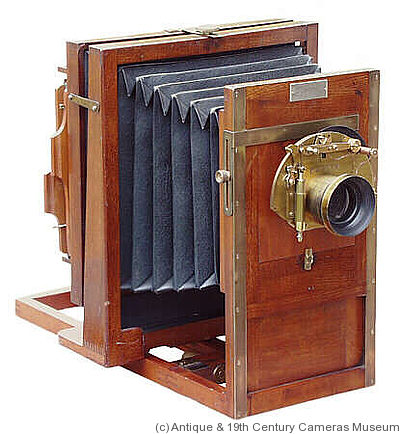
Flammang's Patent Revolving Back Camera
In 1882, E. & H. T. Anthony designed a camera that was light and reversible. This design held the rear of the camera in place by using key bolts. To reverse the camera, the user disengaged the key bolts, which revolved the bellows and camera back into a new position. Cameras such as the Novel, the Klauber, the Fairy, the Phantom Views, and some types of Novelettes used this new technology.
Seemingly in response, Skovill Manufacturing Company designed a camera that revolved along a circular brass track, yet the back stayed in place. Spring loaded stops were used to mark the horizontal and vertical. However, the rotating mechanism added considerable size, and the camera was very large.
Several American manufacturers began making the English-style compact cameras in the late 1880s. This style could sometimes fold to less than 3 inches deep. Many lenses could not fit into such a small camera, so many makers only created one model of compact styles for their brand. The Rochester Optical company, however, produced a series of these cameras, including the Monitor, Carlton, Universal, and Kentwood. These models had better features and finishes than those offered by other manufacturers.
The unstable, inflammable cellulose film base was replaced with long-lived, safe acetate by Eastman Kodak in 1885. Sensitive photographic papers allowed photographers to use enlargers, making it possible to use smaller camera formats while still printing large photographs. There were improvements in lens optics and the discovery of new glasses, designs, and grinding techniques. Cameras became smaller and more sophisticated.
Simon Wing took out a patent in 1887 for a “multiplying camera”, which allowed the photographer to produce many images on a single plate. This camera involved panels to shift the lens vertically and horizontally, as well as a ball and socket mount that allowed the lens tube to tilt universally. The camera also had the rigid back which allowed the camera to work as a multiplying apparatus. There were clusters of lenses to take the several pictures, and the plate's parts were required to be equidistant from the lens so they could properly focus. This model also had a fixed ground glass frame, ¼” thick plateholders, and a rail lock for mounting. The shifting option cost consumers an additional $2.
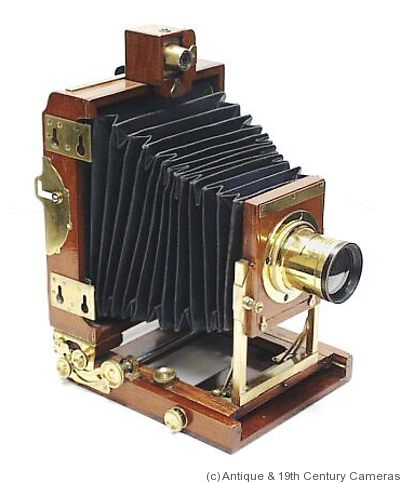
Anthony's Phantom Camera
Camera makers began to offer models with convertible formats in the 1890s. One example is the Blair reverse pullback camera, which featured the traditional rise/fall front stand, folding bellows, tilting rear standard, and reverse back for landscapes and portraits without the need to rotate the whole apparatus. This model also provided an extended grill system and extension back that allowed the user to upgrade the camera to a larger format when needed. Also during the 1890's, Hurter and Driffield devised an independent system to provide speed numbers for varying key motions, which led to the ISO numbers currently on film boxes.
Another invention of this decade was half-toned photographic reproductions, which were produced in daily papers. These are created with the use of a camera that contained a ground glass screen printed with a grid pattern so the image could be broken into different sized dots. This helped add clarity to the newspapers' images, which were using black and white printing with in-between tones before this time.
In 1892, a company owned by S.N. Turner introduced a bull's eye camera. Previous to this invention, photographers were required to load film into their cameras in the dark. However, Turner's invention introduced film that was backed with black paper so it could be safely loaded in daylight. The photographer could see the exposure number through a small red window on the back of the camera. The Eastman Kodak Company bought Turner's patents and company in 1895.
In total, there were fewer than 30 companies making field few cameras in the 19th century. They included:
- American Optical Company
- E. & H.T. Anthony
- Blair Camera Company
- G. Gennert Company
- E. I. Horsmen
- Franklin Tourograph and Dry Plate
- E. Gordon
- Quta Camera and Plate Company
- Rochester Optical Company
- Skovill & Manufacturing Company
- Jas. H. Smith & Company
- Nathan Stockwell
- Bausch and Lomb
- Gundlach
- Wollensack
- Ilex
- The Monroe Camera Company
- Eastman Kodak Company
Another B&L employee, Andrew Wollensack, started at Bausch and Lomb just to leave and start Wollensack Company, which manufactured lenses, shutters, and more until 1958. Two more Bausch and Lomb employees named Klein and Brueck left their jobs as shutter designers to create the shutter delay mechanism, which involved a rocking plate and rotating gear. Their new company was called XL Manufacturing Company, and it manufactured their new shutter. They eventually changed their name to Ilex, and the company still exists today.
Field viewer cameras went through an astonishing evolutionary process throughout the 1800s. This may be partially because there were so many new inventions being created, then taken and used by new companies. Camera manufacturers were constantly competing against other companies who had inside knowledge of their own business, products, and inventions because of job-hopping employees. Cameras evolved from wooden boxes with a tiny hole to models that are very similar to view cameras used today. By the beginning of the 20th century, they were made of wood and featured rear and front standard monorail or sliding rails that were fixed to the flatbed, which attached to the camera support. When the bellows was folded, the flatbed could be folded to reduce the camera to a light, small, portable box. The experiments of the preceding century brought about exciting new changes as they led to handheld cameras. Before 1888, the glass plate cameras were very large and limited to the perspectives that could be shot from the tripod. Because they were able to pick up the cameras and shoot pictures in the early 20th century, practitioners of other disciplines and amateurs could experiment with photographic perspective to explore their own ideas and creativity. Modern photographers still work with perspective in order to give pictures a dynamic, unique appearance and attitude.
Glass plate view cameras' were quickly phased out during the early 1900s, and leather-covered cameras that could fold and use sheet film were manufactured by the score. Companies like the Rochester Optical Company and Century Camera Company created dozens of new models with slightly differing lenses and accoutrements. Amateurs started using the smaller models, and view cameras were once again used by the professional for panoramas, cityscapes, and events.
The Century camera company was founded in 1900, and their first camera model had many improvements to former models, such as utilizing the same rack and pinion gears for the back and front focus. The front and back standards were placed in their own respective grooves within the rails. This caused the extinction of many view camera designs that had been made previously. Older models like the Rochester View and Empire State were altered by the company to match the new Century's design.
Amusingly enough, the invention of air conditioning in 1902 was a big benefit to photography, as photographic materials could be better stored in a cool, dry environment during inclement weather, humidity, and heat.
The 20th century brought more improvements to the photographic processes with some revolutionary inventions. Films were created to work with increasing speed in a broad and color sensitivity. Although early photographic emulsions were sensitive to blue, Autochrome, Kodachrome, and other panchromatics for full color were gradually developed. Several color processes were invented during the 19th century, Autochrome was the first commercially available color process and was introduced in 1907 and eventually discontinued in 1932. These produced positive color transparencies with glass plates in gave fantastic results. Kodachrome was the first affordable and practical cellulose transparency process, and was introduced by Eastman Company in 1935.
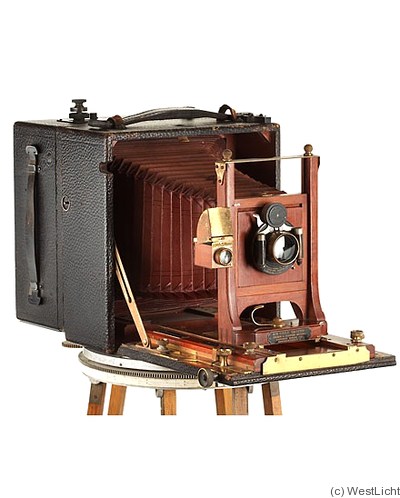
Kodak Eastman, Cirkut No.8
The Ernemann Ermanox-Camera, introduced in 1924, had a lens boasting an F/2.0 next on aperture, which was fast enough to allow photography without bright light. The first electric flashbulbs were introduced to the market in 1930, although electrically ignited magnesium had been used previously for artificial illumination. Photographic electronic light meters were brought to the market in 1931. Prior to this date, the exposures were determined by the experienced photographer or with crudely constructed comparison devices. This allowed the photographers to properly set their aperture and shutter speed with the light readings provided by the light meters.
Modern History
The Polaroid process was introduced by Edwin Land in 1947. This produced a finished monochrome print one minute after the film was exposed. Instant photography allows you to see color images Within moments. More recent advances include metering, shutter speed setting, aperture setting and focusing that were performed by the cameras' automated systems. Film is continuously improving, with smaller grain and more sensitive the motions.Of course, most people today use digital cameras, which do not use film at all. A sensor within the camera records the scene when the shutter opens and records the picture to a memory card. Many folks do not bother getting most of the pictures printed At all, as they can see them on their computer screen or other digital device. They have instantaneous access to their photographs on the camera's screen, and can retake the picture if it is not to their liking.
Photographers do still use the field view cameras, however. The wooden boxes are now sometimes made of carbon fiber or other strong, light composites. The bellows can still be retracted and folded up to make the camera smaller and more portable. The cameras with two sliding rails keep the camera from folding as small as the monorail design, and the rear standard may be fixed and will not move. These field cameras are often used for landscape and portrait photography use 11x14 film or larger. They can also shoot panoramic film up 24x10 or 8x20. In addition, they are used to occasionally shoot posed, large groups and other special events.
The modern view camera works much as the original. The shot is composed and focused on the rear ground glass plate. The frame assembly and ground glass are known as the spring back, and are held in place by springs that pull to hold the glass firmly for the plane of focus during composition and focusing. When the picture is focused, the springs act as a flexible mechanism to clamp the film holder to the same focus plane of the ground glass. The shutter is then closed, the aperture and shutter speed set, the dark paper is removed from the film to reveal the film sheet, the shutter is triggered to make the exposure, and the dark film slide is replaced in the film holder to protect the image. The large negative size allows the photographer enhanced detail and small grain for the printing process. The ability to tilt and shift the image without the digital photo manipulation is a plus to landscape and portrait photographers, although many still utilize programs such as Adobe Photoshop to correct perspective and other issues with the finished print.
Today, there are over 40 companies that manufacture large format cameras all over the world. Bender photographic produces a wooden model field camera kit that the photographer assembles on site. Calumet, Cambo, and Sinar produce monorail cameras and other accessories. Gandolfi has been producing wood field cameras since 1885. Wood view cameras are also produced by Wisner and Ebony, while Canham, Toyo, and Wista offer wood and metal field cameras. Toho and Tachihara Professional Camera Works offer ultralight monorails for shipment around the world.
Companies such as Nikon, Fujinon, Cooke, Sinar, and Schneider Kreuznach offer high quality lenses for the view cameras, while companies such as Caltar and Linhof offer rebranded professional lenses.
Modern cameras can use sheet film or roll film. Roll film can range in size up to 26x17 inches. Roll film backs can be found for the back of the smaller view cameras, which allows you to use this less expensive option rather than the sheet film. Films 8x10 and larger provide excellent contact prints, although it can be considerably more expensive than the roll film for smaller sizes.
As you can see, there are plenty of view camera enthusiasts who choose to build or buy their own cameras in the modern day. There are many articles and resources online that can help you with advice, instruction, and tips if you would like to jump into view camera photography, or if you're just interested in its fascinating history. Here are some of them:
Field Cameras of the United States: 1879-1930
Large Format Photography
Antique Cameras Price Guide
Photographica.nu
Antique Wood Cameras