Unknown Field Camera 3 E. & H. T. Anthony (probably) Microscope Camera
Date Introduced: – ; Years Manufactured: c. 1890
Construction: rear focus via sliding on rods; no swing; non-reversing
Materials: mahogany body; no base; black fabric bellows; brass hardware
Sizes Offered: 4×5 (illustrated);
References:
E.&H.T. Anthony Catalog, February, 1898, p. 19
E.&H.T. Anthony Catalog, April, 1900, p. 45
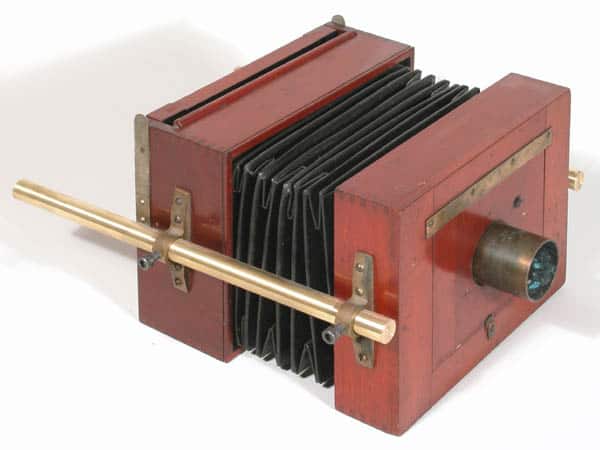
Initial Thoughts: I suppose this could have been part of a magic lantern or enlarger, but in that case, I don’t understand the function of the ground glass. The brass rods are an attempt at reconstructing how this camera would function. There is no wooden track or bed, nor was there ever one, as the bottom of the camera bears no screw holes, nor even a tripod mount. The four brass rings on the sides are original, but the 1/2″ diameter rods and set-screws are new. Apparently, the camera would be focused by sliding the front or back on the rods, and secured by the set-screws. The blackened lens barrel, which now contains no lens, has made the only screw holes in the original lensboard, so presumably is original equipment. Oddly, it has been mounted from the inside, and traverses a neatly made hole to the front of the lensboard. When purchased, a shutter and rapid rectilinear lens marked “American Camera Co.” was screwed into the rear of the lens barrel, and a hole had been drilled into the lensboard to accommodate a rubber tube to trip the shutter. It is unknown whether the American Camera Co. or its founder, Thomas Blair, is responsible for this design. It certainly is weird enough to be a Blair design. The rear of the camera sports a ground glass frame that can be completely removed by sliding it out. The ground glass is protected in transit by a hinged solid wood back. To take a picture: the image would be focused on the ground glass with the back down (as illustrated above); then the ground glass would be pulled up and removed, the back tilted back up in place, a plateholder or darkslide(a horizontal 4×5 plateholder measuring a scant 1/2″ thick) inserted, the dark slide pulled, and the shutter actuated. The camera may have used single darkslides, which are thinner than double darkslides. No wonder it didn’t catch on.
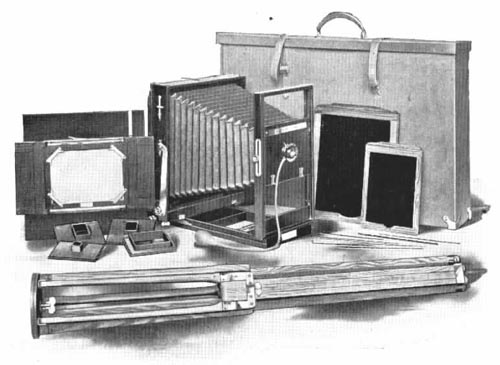
Identified: The engraving below is in the 1903 Anthony Catalog. The illustrated camera does not have the same back, but the brass rod focusing is unmistakable. The wooden back protecting the ground glass is provided apparently because it faces upwards. It is called a microscope camera in the catalog, but this type of work is now called macro (magnifications <1).